Blackjack, often dubbed the ‘game of 21’, is renowned for its blend of skill and chance. While the dealing of the cards remains unpredictable, understanding the odds and probability could provide a strategic edge.
Whether you’re intrigued by the game’s allure or are aiming to refine your strategy, this guide will help you to understand the complexities of blackjack odds.
Basics of Blackjack
Understanding the foundation of blackjack is essential, not only for newcomers but also for seasoned players aiming to rekindle their grasp on the game. Here, we’ll lay out the essential rules and card values that form the backbone of every blackjack game.
If you want to dive deeper into the game though, check out our guide on how to play blackjack for a more detailed look.
How the Game Works
Blackjack is typically played with one to eight standard decks of 52 cards. The primary objective is to have a hand value closest to 21 without exceeding it, whilst also aiming to have a higher value than the dealer’s hand. If a player’s hand goes over 21, it’s termed a ‘bust’, and they lose the round.
Card Values
In blackjack, card values are straightforward:
- Number Cards (2-10): These cards are worth their face value. For instance, a 5 of Spades is worth 5 points.
- Face Cards (Jacks, Queens, Kings): Each of these cards is worth 10 points.
- Aces: They’re unique in that they can be worth either 1 point or 11 points, depending on which value benefits the hand more. For instance, if a player has an Ace and a 7, their hand can be worth either 8 or 18. This flexible nature of the Ace makes it a pivotal card in blackjack strategy.
Understanding Odds and Probability
In the world of gambling, terms like ‘odds’ and ‘probability’ are often bandied about. They’re pivotal in helping players make educated decisions. To grasp their relevance in blackjack, it’s vital first to understand what they represent.
Definitions
- Odds: This term represents the ratio of an event occurring to it not occurring. For instance, if a single event has odds of 1:4, it suggests that for every time it occurs, it won’t occur four times.
- Probability: Probability expresses the likelihood of a particular outcome. Represented as a percentage, it’s calculated by dividing the number of desired outcomes by the total possible outcomes.
Application in Blackjack
In any variations of blackjack, understanding odds and probability can drastically influence a player’s game strategy. Every situation and potential decision has associated odds of winning or losing, and by understanding these, players can tilt the balance in their favour, even if only slightly.
- Dealer’s Upcard: The visible card of the dealer can provide a hint of the possible outcomes. For example, if the dealer has an upcard of 6, there’s a higher probability that they’ll bust, as opposed to when they have a face card.
- Player’s Hand Value: The value of a player’s hand, combined with the dealer’s upcard, offers clues about potential results. For instance, with a hand value of 11, the odds are in favour of receiving a 10-value card next (because face cards and 10s are more frequent in a deck).
House Edge in Blackjack
In every casino game, there’s an inherent advantage favouring the house, known as the ‘house edge’. It’s a percentage that represents the profit the casino expects to make from each bet over the long run.
In blackjack, the house edge is relatively low compared to other casino games, typically ranging between 0.5% and 2%. This percentage can vary based on the specific rules of the game and the strategy employed by the player. For players, a lower house edge means they stand a better chance of winning in the short term.
However, over extended periods, the casino still has a slight advantage. That’s why it is very important to play responsibly. If you need information on doing so and want to see what tools are available to help, check out our Safer Gambling Portal.
The Odds of Getting a Blackjack
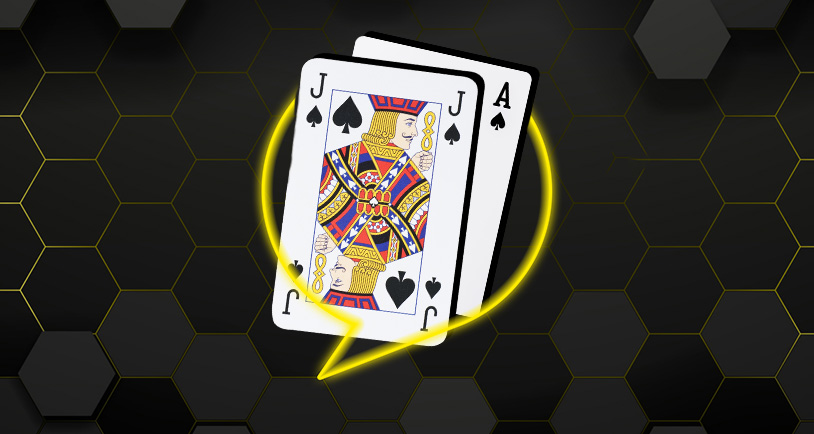
In a single 52-card deck, there are 4 aces and 16 cards worth 10 points (10s, Jacks, Queens, Kings). The probability of getting an Ace followed by a 10-value card is: (4/52) * (16/51) = 2.41%. The odds are the same for receiving a 10-value card followed by an Ace. Thus, the combined probability is approximately 4.82%.
However, keep in mind that in most casinos, multiple decks are used, which can slightly alter these probabilities.
Odds for Different Player Hands
When playing blackjack, understanding the odds of busting on different hands can inform whether you should hit or stand. Here’s a quick breakdown:
- Total of 11 or less: 0% bust chance (impossible to bust).
- Total of 12: 31% bust chance if you hit.
- Total of 13: 38%.
- Total of 14: 46%.
- Total of 15: 54%.
- Total of 16: 62%.
- Total of 17 or more: 69-99% bust chance if you hit.
Playing Blackjack at talkSPORT BET
At talkSPORT BET, we take pride in offering a premium blackjack experience to our players. With intuitive gameplay, high-definition graphics, and authentic sound effects, you’ll feel like you’re sitting at a real casino table.
Don’t forget to check out our promotions page for the latest blackjack bonuses and offers before you sit at the table.
18+ | Opt in | T&Cs apply | begambleaware.org | Please gamble responsibly
FAQs on Blackjack Odds & Probability
Yes, the number of decks can influence the odds. Generally, the house edge increases slightly with more decks.
The hand value occurring most frequently is 20, as there are more cards valued at 10 than any other value.
The dealer’s upcard gives insights into their potential hand strength. For instance, if the dealer has a low-value card, they have a higher chance of busting.